
Class I Division 1 and Division 2 are North American hazardous-location classifications for flammable gases or vapors. Division 1 addresses defined conditions in which an ignitable concentration may be present during normal operation or frequently. Division 2 generally addresses abnormal release, ventilation failure, or exposure from an adjacent Division 1 location.
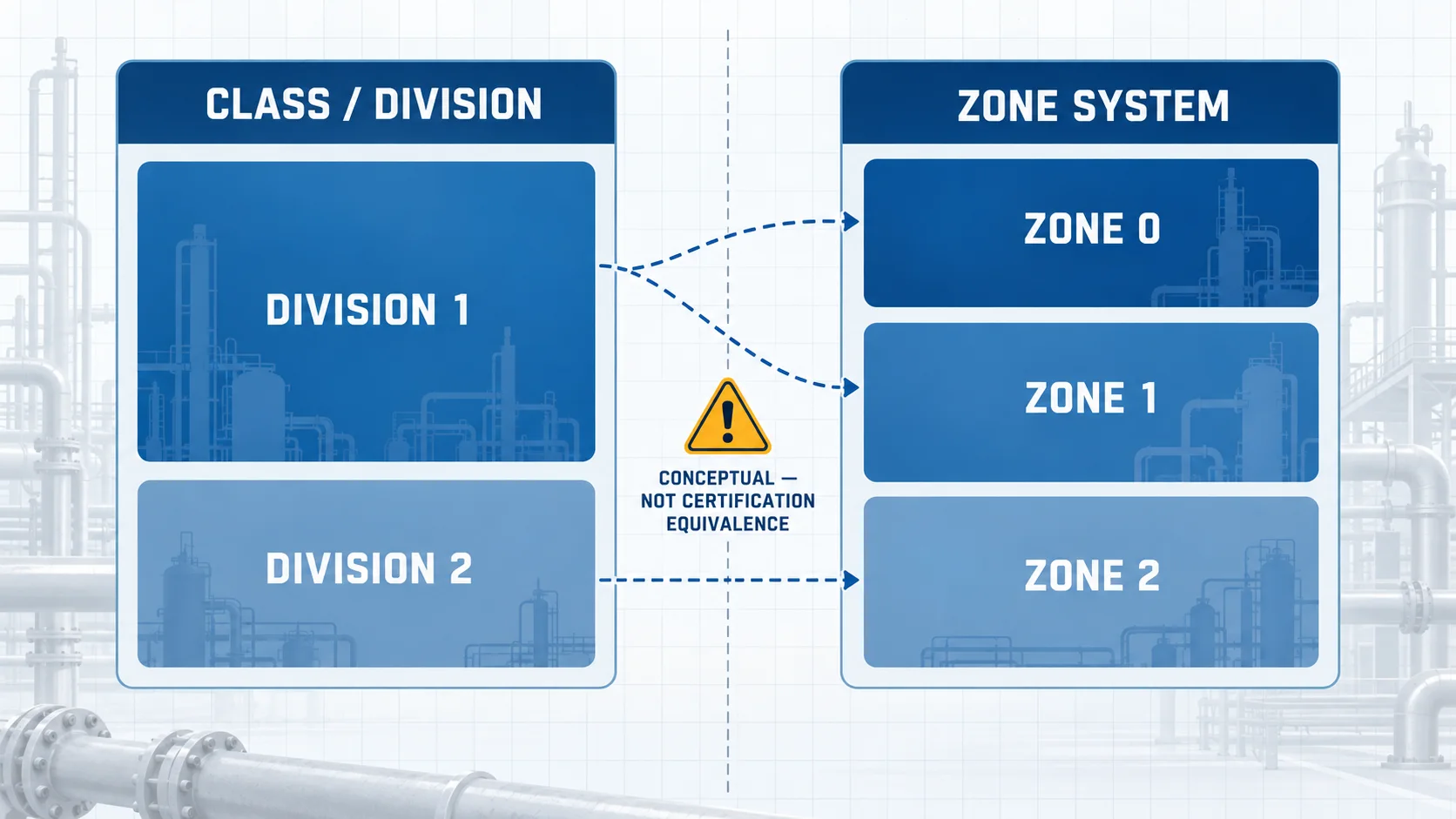
Zone 0, Zone 1 and Zone 2 describe frequency and duration differently. They are useful comparison points, but Division 1 is not automatically Zone 1, and Division 2 is not a certificate-level synonym for Zone 2. A luminaire is acceptable only when its complete marking, approval or certificate, conditions of use, installation method and local acceptance all fit the project.
Selection rule: treat a Division-to-Zone table as orientation, not as a conversion certificate. Start with the project’s hazardous-area classification, adopted code and authority having jurisdiction (AHJ), then verify the exact luminaire variant and its documents.
What do Class I, Division 1 and Division 2 mean?
In the North American Class/Division framework, Class I identifies locations where flammable gases or vapors are, or may be, present in the air in quantities capable of producing an explosive or ignitable mixture. Class II concerns combustible dust, while Class III concerns easily ignitable fibers or flyings; those hazards require separate analysis.
For Class I locations, the distinction between the two divisions is about the conditions under which the hazard may exist:
- Division 1: ignitable gas or vapor concentrations may exist under normal operating conditions; may exist frequently because of repair, maintenance or leakage; or may be released while equipment failure simultaneously creates an ignition source.
- Division 2: volatile liquids or gases are normally confined and would escape only through accidental rupture, breakdown or abnormal operation; ventilation failure could create ignitable concentrations; or the location is adjacent to a Division 1 area and vapors could communicate with it unless suitable safeguards are used.
These are condensed planning descriptions, not substitutes for the adopted code. The public definitions appear in OSHA 29 CFR 1910.399, while equipment and installation obligations for hazardous locations appear in OSHA 29 CFR 1910.307. The electrical design must use the NEC edition adopted for the project and the AHJ’s requirements, not simply the newest edition listed by NFPA. NFPA identifies the NEC as NFPA 70.
What this changes for lighting
A request for a “Class 1 Division 2 light” is not a complete specification. At minimum, a buyer still needs the material group, temperature requirement, ambient range, environmental exposure, supply, mounting and required listing or approval. “Class I, Division 2” describes only part of the installation condition.
A luminaire suitable for one Class I location may still be unsuitable for another because the gas group, maximum surface temperature, ambient conditions, approval scope or installation restrictions differ.
What do Zone 0, Zone 1 and Zone 2 mean?
The gas/vapor Zone framework separates locations by how often and how long an explosive gas atmosphere is expected:
- Zone 0: an explosive gas atmosphere is present continuously, for long periods, or frequently.
- Zone 1: an explosive gas atmosphere is likely to occur occasionally in normal operation.
- Zone 2: an explosive gas atmosphere is not likely in normal operation and, if it occurs, exists only for a short period.
These definitions are reflected in OSHA’s Class I Zone provisions and in the EU workplace framework. In Europe, Directive 1999/92/EC requires the employer to assess explosion risks and classify places into Zones. Internationally, IEC 60079-10-1 addresses classification of areas where flammable gas or vapor hazards may arise.
Zone 20, Zone 21 and Zone 22 apply to combustible dust atmospheres. They must not be selected from the gas/vapor table below.
Class I Division 1 vs Division 2 and Zone cross-reference
The following table compares the hazard logic only. It does not establish that equipment approved under one system is certified under another.
| Project classification | Simplified condition | Nearest Zone concept for orientation | What the comparison does not prove |
|---|---|---|---|
| Class I, Division 1 | Ignitable gas/vapor concentrations may occur in normal operation, occur frequently during maintenance or leakage, or coincide with equipment failure | Depending on the source, release grade, ventilation and persistence, the classified space may involve Zone 0 or Zone 1 conditions | It does not prove Division 1 = Zone 1, nor that Division-approved equipment has ATEX or IECEx conformity |
| Class I, Division 2 | Gas/vapor is normally confined; hazard is associated with abnormal release, ventilation failure or communication from an adjacent Division 1 area | Often closest in operating concept to Zone 2 | It does not prove that every Division 2 boundary matches a Zone 2 boundary or that the same luminaire marking is acceptable |
| Zone 0 | Explosive gas atmosphere is continuous, long-lasting or frequent | No single universal Division label | It does not permit selection of ordinary Division 1 equipment without a marking and approval that covers the application |
| Zone 1 | Explosive gas atmosphere is likely occasionally in normal operation | Part of the risk space commonly associated with Division 1 | It does not convert an ATEX or IECEx document into a North American listing |
| Zone 2 | Explosive gas atmosphere is unlikely in normal operation and, if present, persists briefly | Broadly comparable to the abnormal-condition logic of Division 2 | It does not make all Zone 2 and Division 2 products interchangeable |
Why is there no exact one-row conversion? The two systems classify hazardous space using different structures and design practices. The final boundary can change with the release source, ventilation, material properties, process conditions and the rules adopted in the jurisdiction. OSHA also requires each room, section or area to be considered individually and requires hazardous-area documentation to be available to those who design, install, inspect, maintain or operate the equipment.
NEC, ATEX and IECEx do different jobs
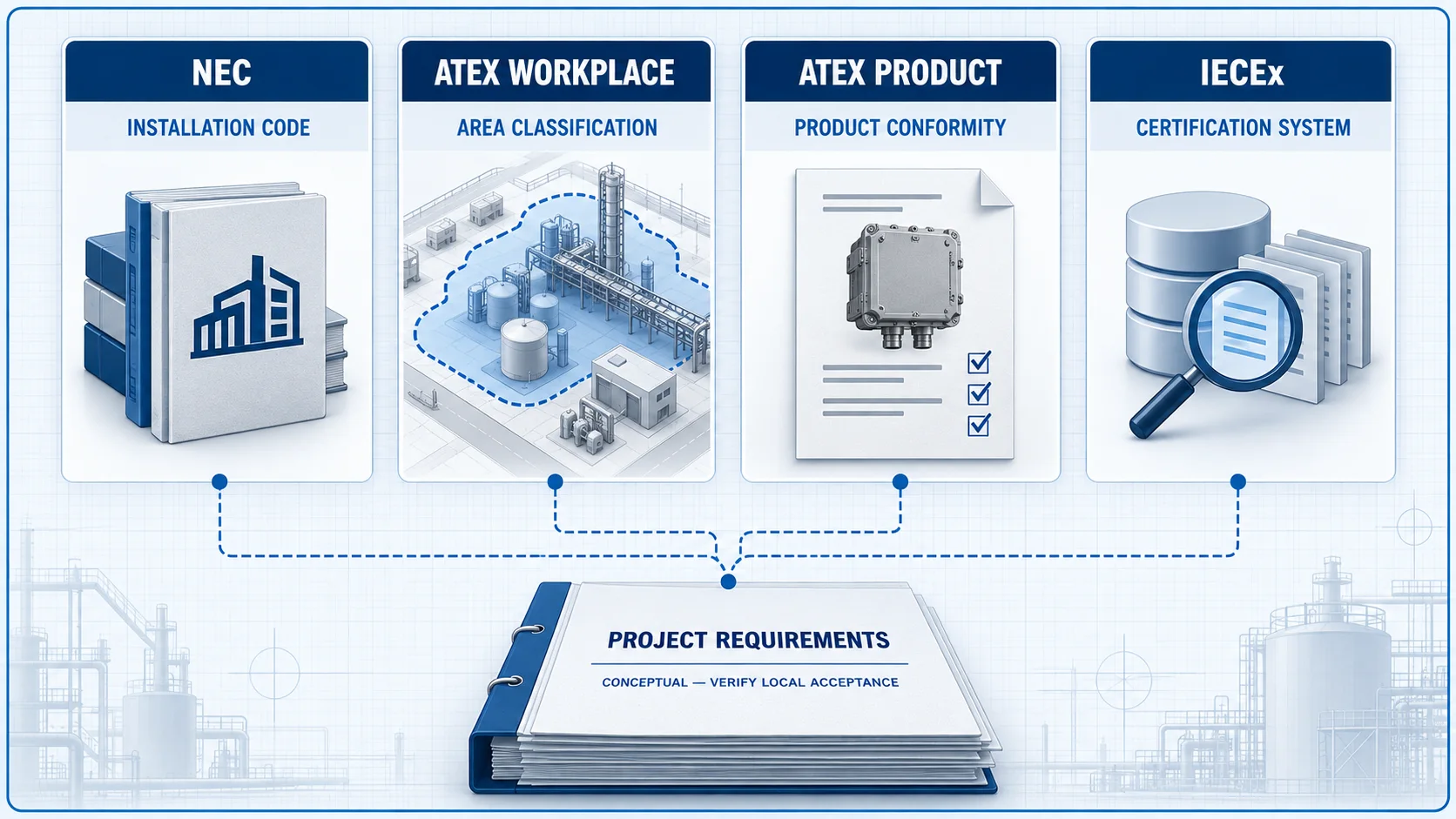
NEC, ATEX and IECEx are often grouped in one procurement sentence, but they are not three interchangeable labels.
| Framework | What it is | What it controls for a lighting project | Evidence to request |
|---|---|---|---|
| NEC / North American installation framework | An electrical installation code adopted and enforced by jurisdictions; OSHA rules also establish workplace obligations | Area-classification method, acceptable equipment and wiring methods, installation and inspection under the adopted rules | Adopted code edition, area-classification drawing/schedule, listing or approval details, luminaire marking and installation instructions |
| ATEX workplace framework | EU minimum workplace requirements under Directive 1999/92/EC | Employer risk assessment, hazardous-place classification and organizational/technical protection measures | Explosion-protection document, Zone drawing, material and process data, required equipment category |
| ATEX product framework | EU equipment requirements under Directive 2014/34/EU | Conformity of equipment and protective systems placed on the EU market, including applicable marking and documentation | EU declaration of conformity, notified-body documents where applicable, instructions, exact equipment marking and special conditions |
| IEC standards | International technical standards in the IEC 60079 family | Area classification, protection concepts, equipment construction/testing, selection and installation, depending on the adopted standards | Exact standards and editions named by the project, equipment marking, certificate scope, installation instructions and conditions of use |
| IECEx | An international conformity-assessment system using IEC standards | Independent certification of specified equipment, service facilities or personnel within an IECEx scheme | Online IECEx certificate record, current status, exact model/variant, certificate schedule and any conditions of certification |
The ATEX workplace directive links Zones to equipment categories unless the risk assessment provides otherwise: Category 1 equipment in Zone 0/20, Category 1 or 2 in Zone 1/21, and Category 1, 2 or 3 in Zone 2/22. The equipment categories and protection objectives come from the separate ATEX product Directive 2014/34/EU. That legal relationship is not the same as saying an ATEX-marked luminaire is automatically accepted on an NEC project.
Similarly, IECEx is not a zoning law. The IECEx Certified Equipment Scheme provides a route for equipment certification to IEC standards. The certificate belongs to a defined scope, and the IECEx certificate FAQ explains how certificates are issued and verified through the system. Project acceptance still depends on local legislation, the specified scheme and the exact certificate status and schedule.
How to specify Class I Division 1 or Division 2 lighting
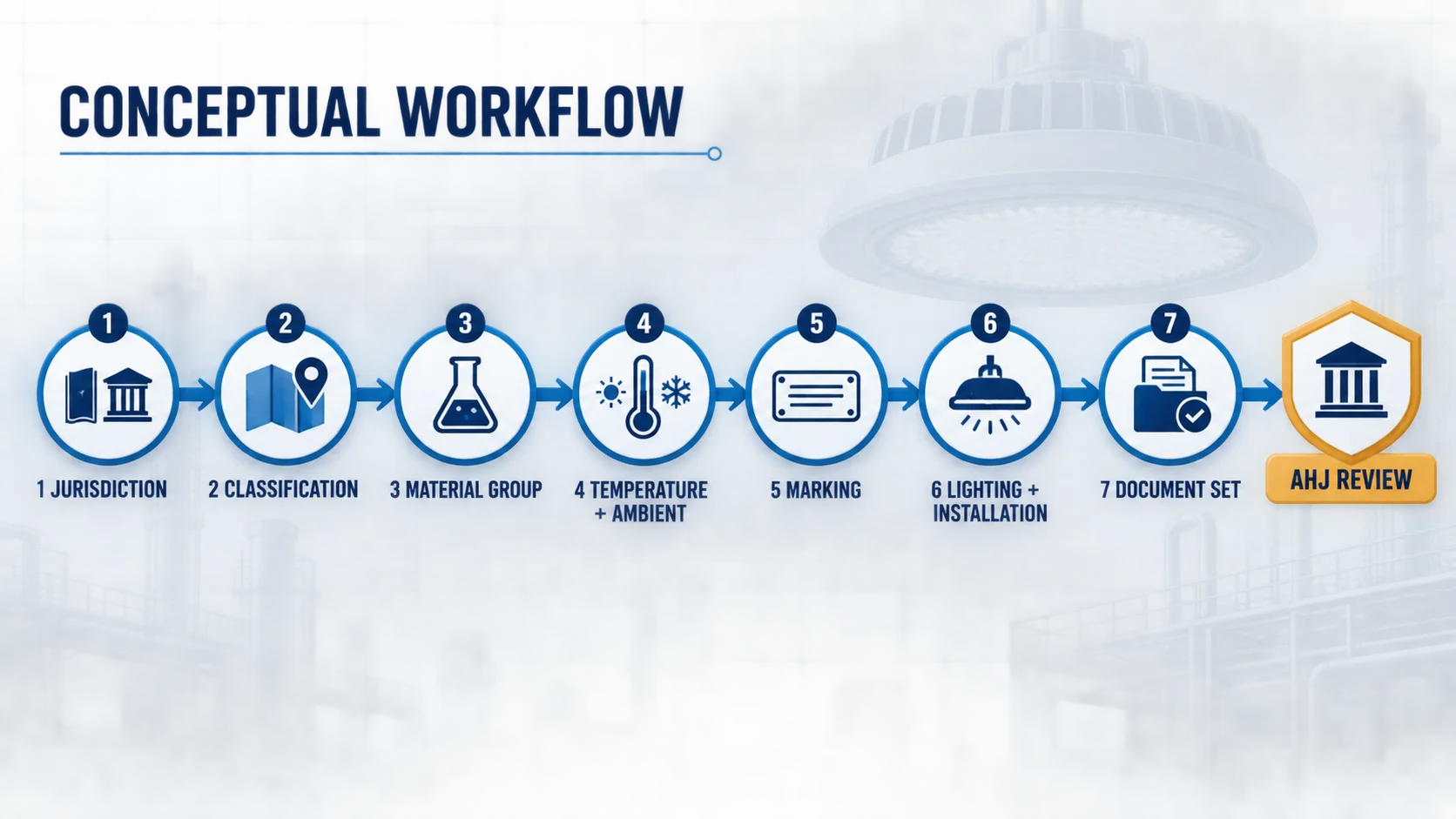
Use the classification as the start of a controlled selection workflow, not as the complete product description.
1. Establish the governing jurisdiction and adopted documents
Record the country, state or province, site owner specification, adopted electrical code and required conformity scheme. A project may cite more than one standard for contractual reasons, but that does not make their approvals interchangeable.
Where the project uses the NEC Class/Division system, confirm the adopted edition and local amendments. Where it uses Zones, identify whether the legal basis is an NEC Zone installation, EU ATEX requirements, another national implementation of IEC standards, or a project specification.
2. Obtain the hazardous-area classification package
Do not classify the area from a luminaire catalog. Request the signed or controlled area-classification drawing and schedule from the responsible engineering organization. It should locate the boundary and state the classification system, gas/vapor or dust hazard, group and relevant temperature requirement.
Area classification depends on process and site information. Equipment suppliers can help compare a defined requirement with product documents, but they should not replace the project’s qualified classifier or AHJ.
3. Identify the hazardous material group
“Class I” alone does not identify the material group. In North American Division work, the marking may include Groups A, B, C or D. Zone/IEC equipment uses gas subdivisions such as IIA, IIB or IIC. These group structures are related to material ignition behavior, but they should be read within their own approval framework rather than converted from memory.
Provide the actual gas or vapor and the classification group’s project designation. If the certificate covers only a narrower group or the marking does not match the project, stop the selection.
4. Check temperature class and ambient conditions together
The equipment’s maximum surface temperature or temperature class must remain appropriate for the hazardous material under the rated conditions. Do not compare a T-code with the material’s autoignition temperature and ignore the certified ambient range, supply variation, dust layers or mounting restrictions.
Use the exact nameplate, certificate schedule and instructions for the proposed variant. If a suffix, wattage, driver, battery, mounting arrangement or ambient option changes the certified scope, the general product-family page is not enough.
5. Verify the protection concept and complete marking
For Zone equipment, the marking communicates more than the Zone number. Depending on the scheme, relevant fields can include:
- equipment group and category for ATEX;
- gas or dust atmosphere identifier;
- type of protection;
- gas or dust group;
- temperature class or maximum surface temperature;
- Equipment Protection Level (EPL);
- ambient range when it differs from the normal marking convention;
- certificate number and an
Xsuffix where special conditions apply.
For North American equipment, relevant fields can include Class, Division or Zone, material group, temperature code, environmental type/rating information and the mark of the approving organization. The required format depends on the approval and adopted rules.
This is why a photograph labeled “explosion-proof light” or a datasheet carrying only IP66 cannot establish hazardous-location suitability. An ingress-protection rating addresses enclosure protection against solids and water; it does not replace an Ex approval.
6. Confirm ordinary lighting and environmental requirements
Once the hazardous-location requirements are fixed, complete the luminaire specification:
- input voltage, frequency and control interface;
- emergency function, if required;
- ambient temperature and expected thermal exposure;
- corrosion, chemical, vibration and mechanical-impact conditions;
- ingress and enclosure requirements;
- mounting method, cable entries, glands and accessories;
- maintained illuminance, uniformity, glare constraints and emergency-lighting criteria;
- photometric file and lighting-layout assumptions;
- maintenance access and inspection strategy.
Hazardous-area compliance does not prove that the luminaire will deliver the required lighting performance, and photometric performance does not prove hazardous-area suitability. Both must be checked.
7. Close the document loop before approval
For the exact proposed model and ordered configuration, request:
- product datasheet and complete ordering code;
- nameplate or marking drawing;
- current certificate or listing record;
- certificate schedule, annex or descriptive documents identifying the variant;
- special conditions of use and limitations;
- installation, operation and maintenance instructions;
- declaration of conformity where the applicable framework requires it;
- photometric file and dimensional/mounting drawings;
- confirmation of required accessories, entries and glands;
- AHJ, owner or engineer approval record where required.
IEC 60079-14:2024 addresses electrical-system design, equipment selection and installation, and initial inspection within the IEC framework. Use the edition adopted by the project; an IEC catalog page or IECEx certificate does not by itself establish the applicable local installation rules.
What should a Class 1 Division 2 lighting RFQ include?
A usable RFQ lets the manufacturer compare one defined operating envelope with one exact luminaire configuration. Include the following fields:
| RFQ field | What to provide | Why it matters |
|---|---|---|
| Jurisdiction | Country, state/province, site owner and AHJ | Determines the applicable legal and code framework |
| Classification | Exact Class/Division or Zone notation from the project schedule | Prevents informal conversion by the supplier |
| Hazardous material | Gas/vapor name and specified group | Confirms group compatibility within the required scheme |
| Temperature basis | Required temperature code/class or maximum surface temperature, plus process basis | Supports a controlled temperature check |
| Ambient | Minimum and maximum ambient at the mounting location | Certificate and driver limits may depend on ambient |
| Approval scheme | Required listing, ATEX conformity, IECEx certification or other national approval | Prevents submission of the wrong document set |
| Electrical | Voltage, frequency, phase, controls and emergency duration/function | Defines the orderable electrical variant |
| Mechanical | Mounting, entries, glands, cable type, corrosion/vibration exposure and enclosure needs | Affects installation and sometimes certified scope |
| Lighting duty | Mounting height, target plane, illuminance, uniformity, optics and layout file format | Allows photometric evaluation |
| Documents | Certificate, schedule/annex, declaration, instructions, marking drawing and photometry | Creates a reviewable submittal rather than a verbal claim |
If the project uses both North American and international approval schemes, list each as an independent requirement. Ask the supplier to identify which exact marking and document satisfies each requirement; do not accept “equivalent” as the entire response.
Common mistakes when comparing hazardous-area lights
Treating Division 1 as a synonym for Zone 1
Division 1 can encompass conditions that the Zone framework separates into Zone 0 and Zone 1. The actual classified extent depends on the engineering assessment. A shortcut can understate the hazard or demand irrelevant documentation.
Assuming a higher-hazard approval crosses every boundary
Within one adopted system, equipment intended for a more demanding location may sometimes be permitted in a less demanding location when all other class, group, temperature and installation conditions are met. That principle does not turn a North American approval into ATEX conformity or an IECEx certificate into a US listing.
Checking only the certificate front page
The schedule or annex may identify the exact models, construction options, ambient range and special conditions. A similar family name or catalog photograph is not evidence that the quoted ordering code is covered.
Using IP rating as proof of explosion protection
Water and dust ingress performance is important in industrial lighting, but it answers a different question. Confirm both the environmental enclosure requirements and the hazardous-area approval.
Ignoring the installation system
Cable entries, glands, seals, conduit practices, mounting and maintenance can be part of compliance. Selecting a marked luminaire does not approve an incompatible installation around it.
Letting procurement choose the classification
Procurement should preserve and transmit the engineering classification, not infer it from an old purchase order or a product label. When project documents conflict, return the question to the responsible engineer and AHJ.
A safer way to compare TORMIN hazardous-area lighting
Start with the controlled classification schedule, not a product thumbnail. Then compare the exact requirement with the complete documents for the proposed variant.
You can review TORMIN’s Explosion-Proof Lighting range to identify possible luminaire forms. Category placement, however, is not proof that a model is suitable for a specific Division, Zone, gas group, temperature class or jurisdiction.
For a document-led review, contact TORMIN with the classification, hazardous material/group, temperature requirement, ambient range, mounting, electrical supply, photometric target, quantity and required approval scheme. Ask for the current certificate and full schedule or annex for the exact offered model before it enters the project submittal.
Official references
- OSHA 29 CFR 1910.307 — Hazardous (classified) locations
- OSHA 29 CFR 1910.399 — Definitions applicable to Subpart S
- NFPA 70 — National Electrical Code
- Directive 1999/92/EC — worker protection in explosive atmospheres
- Directive 2014/34/EU — equipment for potentially explosive atmospheres
- IEC 60079-10-1 — classification of gas areas
- IEC 60079-14:2024 — electrical-system design, equipment selection and installation
- IECEx Certified Equipment Scheme
This guide supports specification and document review. It does not classify a site, approve a product, replace the adopted code or replace review by the responsible engineer and AHJ.