
Selecting a light for a combustible-dust area starts with the approved area-classification document and the dust data, not with wattage, IP rating, or the word “explosion-proof.” The exact luminaire must then be checked for the applicable dust classification, protection marking, certificate scope, maximum surface temperature, ambient range, entries, mounting arrangement, installation instructions and photometric performance.
This order matters. A luminaire can be dust-tight yet lack approval for an explosive dust atmosphere. It can carry a dust protection marking but fail a project’s ambient, material, entry or optical requirements. And a certified product still does not make an unverified layout, wiring method or maintenance practice compliant.
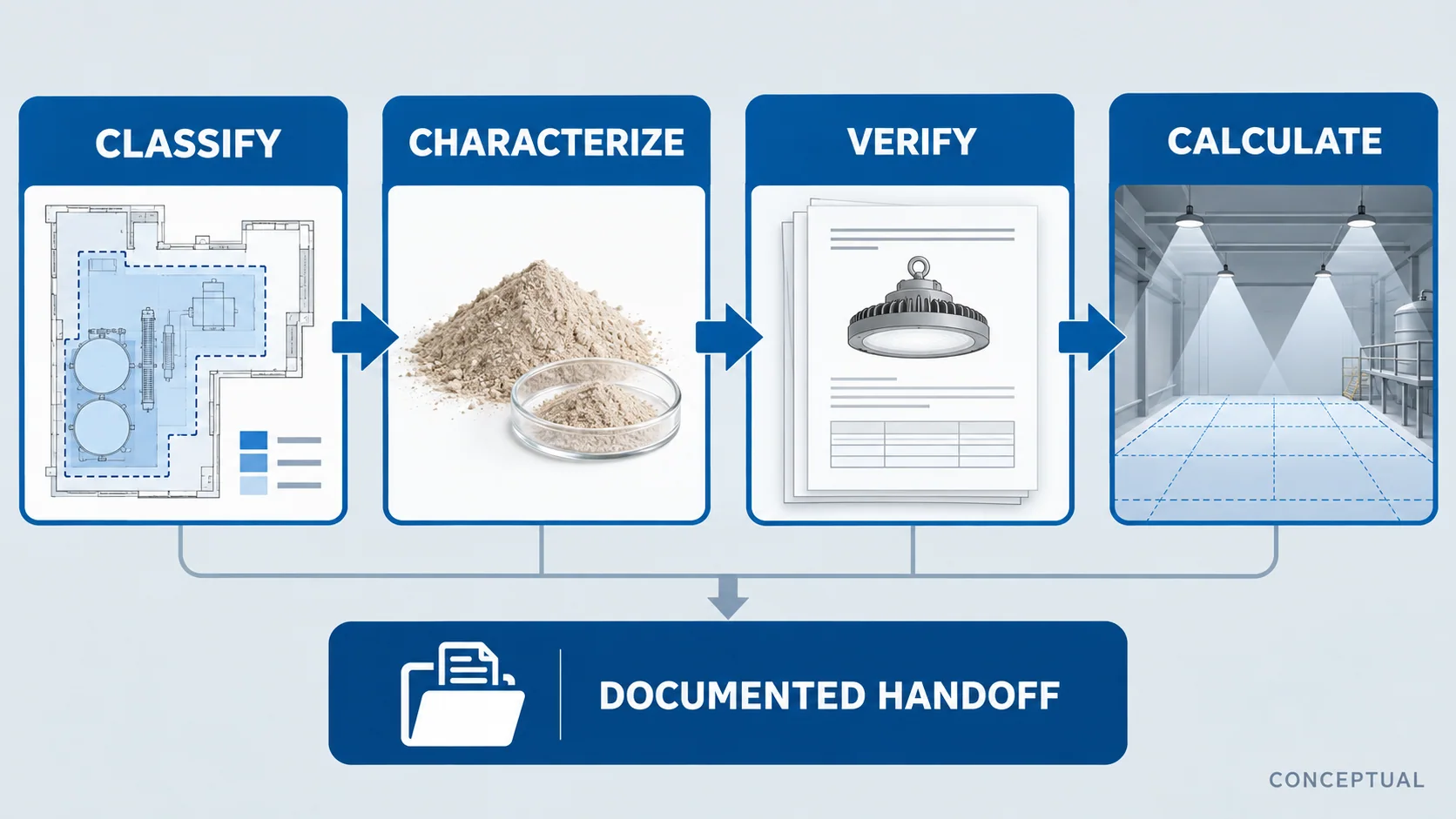
Working rule: classify the location, characterize the dust, define the visual task, and verify the exact product evidence. Treat those as four connected decisions—not one label on a catalogue page.
Why dust changes the lighting decision
OSHA explains that many materials can become explosible when finely divided and suspended in air under the right conditions. Agriculture, food processing, wood products, plastics, pharmaceuticals, coal and metal processing are among the industries where the issue can arise. The facility name alone, however, does not prove that a particular room is hazardous.
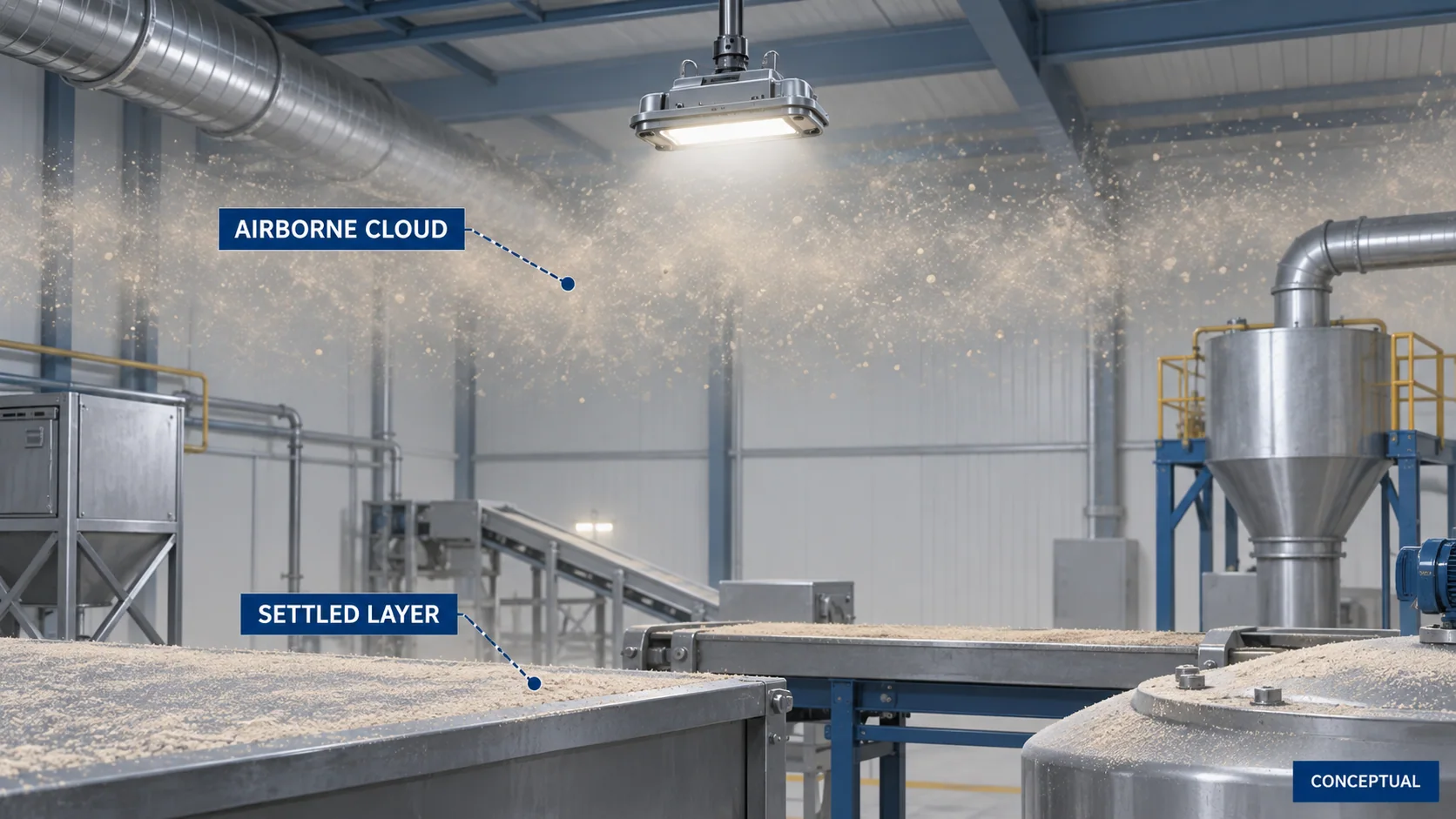
A combustible-dust lighting review must distinguish at least two conditions:
- An airborne dust cloud may place electrical equipment inside a classified location when its occurrence and duration meet the applicable framework.
- A settled dust layer may insulate the luminaire, affect heat dissipation and become a source for a future cloud if disturbed.
The current scope of IEC 60079-10-2:2026 explicitly treats explosive dust atmospheres and combustible dust layers separately. It also makes housekeeping relevant to the classification examples: accumulated layers can become a source of an explosive cloud. That is why “we rarely see dust in the air” is not a complete design input.
Lighting is only one possible ignition source and only one part of the facility’s dust-hazard controls. Process containment, dust collection, housekeeping, bonding and grounding where applicable, inspection, training and emergency planning belong to the wider risk assessment. A certified luminaire cannot compensate for missing process controls.
Map process areas before choosing a luminaire
Do not classify an entire plant from one room name. Start with the process, release points and actual locations of electrical equipment. A useful first survey separates the following:
| Area or task | Dust questions | Lighting questions | Evidence to collect |
|---|---|---|---|
| Inside a bin, silo, collector or enclosed process | Can a dust cloud be present during normal operation? Can layers build up? | Is a luminaire installed inside, viewed through a window, or kept outside? | Process description, classification drawing, access and cleaning method |
| Transfer, tipping, filling, bagging or discharge point | When and how is dust released? What happens during start-up, shutdown or a fault? | Where are the working plane and operator sightlines? Are moving vehicles present? | Release-source map, operating modes, mounting positions and obstruction survey |
| Grinding, sanding, cutting or pulverizing | Which materials and particle distributions are produced? Are mixed materials possible? | Is inspection of moving equipment, color, surface finish or contamination required? | Representative dust data, task criteria, glare and flicker requirements |
| Dust collector exterior, duct route or housekeeping area | Can leakage or maintenance release dust? Can deposits accumulate on the fitting? | Can the fitting be isolated and reached without disturbing deposits? | Maintenance procedure, shutdown window, ambient and access constraints |
| Packaging, warehouse or adjacent circulation area | Is it outside the classified boundary, or can abnormal releases extend into it? | Are vertical labels, rack faces, pedestrian paths or vehicle routes the key tasks? | Approved boundary drawing, elevations, task planes and emergency-lighting brief |
This table does not assign a zone or division. Its purpose is to expose the inputs that a qualified classifier and electrical designer need. The same grain, plastic, wood or metal facility can contain several different classifications—and ordinary locations—depending on process and boundary conditions.
Keep the North American and EU/IEC paths separate
“Dust zone” and “Class II division” are not interchangeable product filters. Select the framework required by the project and follow its adopted rules, documentation and approval route.
United States: Class II, Division 1 or Division 2
Under U.S. federal OSHA rules, 29 CFR 1910.307 covers electrical equipment and wiring in locations classified for flammable gases, vapors, liquids, combustible dusts or fibers. It requires each room, section or area to be considered individually and requires hazardous-location documentation to be available to people who design, install, inspect, maintain or operate the equipment.
For dust, the applicable designation is Class II, with Division 1 or Division 2 describing the seriousness and likelihood conditions defined in the U.S. framework. OSHA also requires equipment to be approved not only for the class of location but for the combustible properties of the specific dust present. Its listed protection techniques distinguish dust-ignitionproof equipment for Class II Divisions 1 and 2 from dust-tight equipment permitted only for the locations and conditions for which it is approved.
Do not carry a Class I gas/vapor approval into a Class II dust decision. TORMIN’s Class I Division 1 versus Division 2 guide deliberately keeps dust outside its core cross-reference; this article owns the dust application task.
EU/IEC: Zones 20, 21 and 22
The EU workplace directive 1999/92/EC defines dust zones by the frequency and duration of an explosive atmosphere in the form of a combustible-dust cloud:
| Dust zone | Workplace meaning in Directive 1999/92/EC | Default ATEX category route* |
|---|---|---|
| Zone 20 | Present continuously, for long periods or frequently | Category 1 equipment |
| Zone 21 | Likely to occur occasionally in normal operation | Category 1 or 2 equipment |
| Zone 22 | Not likely in normal operation; if it occurs, it persists only briefly | Category 1, 2 or 3 equipment |
*The directive states this selection basis applies unless the explosion-protection document based on risk assessment provides otherwise, and the equipment must be suitable for dust as appropriate.
The product-side ATEX directive 2014/34/EU sets requirements for equipment intended for potentially explosive atmospheres. In the IEC system, the exact equipment marking and certificate must show the dust protection scope needed by the project. For example, IEC 60079-31:2022 covers equipment protected by enclosure “t” and surface-temperature limitation for explosive dust atmospheres—but the standard name alone does not prove that a particular luminaire or variant complies.
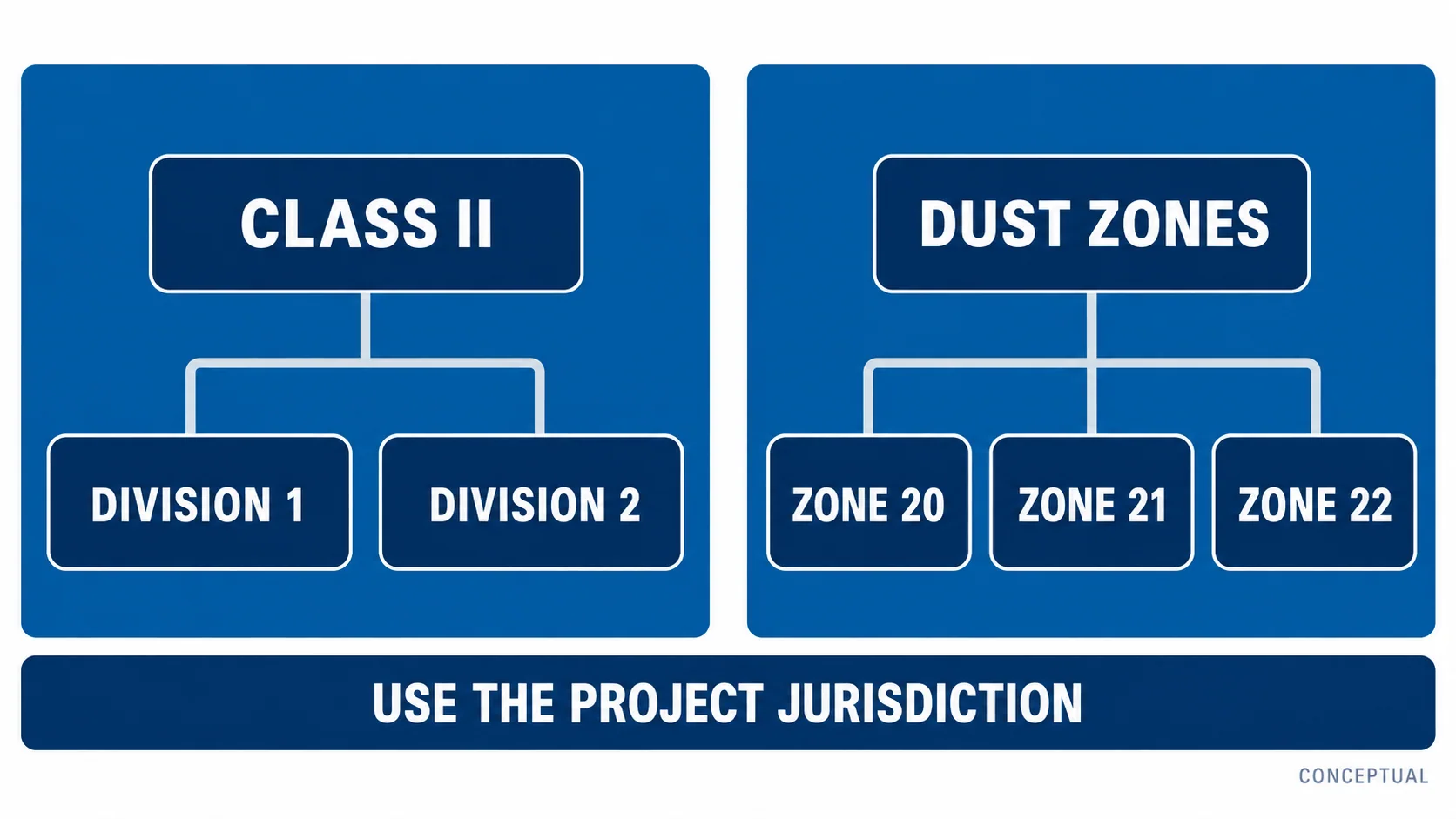
Never choose a North American product solely because a zone number “looks similar” to a division, or an ATEX/IECEx product solely because a Class/Division phrase appears in marketing copy. Verify the approval scheme and exact certificate for the target jurisdiction.
A seven-step specification workflow
1. Freeze the jurisdiction and classification basis
Record the country, authority having jurisdiction, owner specification, adopted code/standard editions and project stage. Attach the current approved area-classification drawing or schedule. If the classification is missing, stop equipment selection and send the issue to a qualified hazardous-area professional.
Do not ask a lighting supplier to invent the classification from a facility photo or the name of the material.
2. Characterize the dust and the process
Identify the actual material or mixture, where the sample was taken, particle-size condition, moisture condition and the competent laboratory data used by the hazard assessment. Record whether fibers/flyings, non-conductive dust or conductive dust are relevant under the selected framework. Include minimum ignition and layer/cloud data only from the project’s accepted test basis.
Also record release points, ventilation or dust-collection state, normal operation, foreseeable abnormal operation, cleaning method and the potential for layers to form on the luminaire. Do not reuse a generic value from a different grain, plastic, wood or metal formulation.
3. Build a location-by-location lighting brief
For every mounting position, document:
- the classified boundary and required protection basis;
- ambient temperature range and nearby process heat;
- dust, moisture, washdown, corrosion, abrasion, vibration and impact exposure;
- mounting height, orientation, structural attachment and maintenance access;
- supply voltage/frequency, controls, emergency function, cable system, entries and earthing requirements;
- task planes, viewing directions, obstructions, maintained illuminance, uniformity, glare, color and flicker criteria from the applicable project authority.
“Ten lights for a dusty workshop” is not a specification. A marked-up plan and schedule are.
4. Match the exact equipment protection evidence
For each candidate ordering code, obtain the current certificate and every schedule or annex, not just a logo image. Match the document to the exact model, construction, wattage or optical variant, entry arrangement, mounting accessory and emergency option being offered.
Check the complete dust-related marking and limitations required by the selected scheme, including the group, equipment protection level/category or Class/Division approval, maximum surface temperature, ambient range and any special conditions of use. IEC 60079-0:2026 is the current IEC general-requirements edition for construction, testing and marking; local adoption and certificate editions still need project review.
A gas marking by itself is not dust evidence. An IP rating by itself is not explosion-protection evidence. TORMIN’s IP versus explosion-protection explainer covers that boundary in more detail.
5. Check the thermal and environmental envelope
The classifier or responsible engineer must compare the equipment’s marked maximum surface temperature and operating conditions with the accepted dust cloud and layer ignition data, including the applicable safety rules for the jurisdiction. Dust layers can change thermal behavior, so the expected deposit and cleaning basis matter.
Separately verify ambient range, solar or process heat, corrosion exposure, cleaning chemicals, washdown, vibration and impact. Do not infer chemical compatibility, corrosion life or suitability for high-pressure cleaning from a dust approval or IP code alone.
6. Complete the lighting design
Hazardous-area approval answers whether the equipment is suitable for the classified risk within its certified conditions. It does not prove that workers can see the task.
Request the exact photometric file for the offered optical variant and calculate the layout with the real geometry, reflectances, obstructions, dirt/maintenance assumptions, mounting positions and target criteria. Evaluate horizontal and vertical task planes where relevant. Review glare, shadows, uniformity, emergency mode and control behavior rather than selecting by lumens, watts or nominal beam angle alone.
7. Verify installation, inspection and maintenance
IEC 60079-14:2024 covers design, selection, installation and initial inspection of Ex electrical installations, including documentation and personnel competency. The applicable national code, certificate conditions and the exact manufacturer’s instructions control the real installation.
The package should resolve cable type, entry thread, certified glands and stopping plugs, conduit or cable sealing, earthing/bonding, mounting loads, isolation, access, torque and inspection requirements. Maintenance planning should define safe isolation, external inspection, cleaning method, deposit control, damage criteria and the authority for repair. Do not open, modify or repair Ex equipment from a generic blog procedure.
Industry questions that change the brief
The workflow stays consistent, but the questions change with the process. These prompts prevent an industry article from becoming a product list with a different noun.
Grain and food handling
Map receiving pits, bucket elevators, conveyors, bins, mills, dryers, bagging points and dust collectors separately. Record fumigation or cleaning chemicals, humidity/condensation, food-hygiene requirements and access above equipment. Do not assume every grain-storage room has the same classification or that one dust sample represents every product handled.
Woodworking and biomass
Separate cutting, sanding, extraction, conveying, collection and storage. Document fibrous material, dust deposits on overhead structures, duct leakage, resin or coating exposure and the effect of changing feedstock. Optical planning must account for machinery, timber stacks and deep shadows as well as the classified boundary.
Plastics and recycling
Identify each polymer and additive stream, size-reduction stage, separation process, transfer point and any independent gas/vapor hazard. Mixed feedstock and changing contaminants make unsupported generic dust values particularly risky. If a gas/vapor hazard is also documented, assess both hazard systems; do not assume one approval automatically covers the other.
Metal processing and additive manufacturing
Record alloy, process, particle condition, collection method and conductivity-related requirements. Keep ordinary machining swarf, combustible metal dust and pyrophoric or reactive materials within the scope defined by the project’s competent hazard assessment. Some reactive materials and explosive substances sit outside the normal scope of the standards discussed here.
The exact evidence package to request
Before approving a luminaire, assemble one traceable folder for the offered ordering code:
- Approved area-classification drawing and equipment schedule.
- Dust hazard analysis and accepted material test data.
- Applicable jurisdiction, code/standard editions and owner requirements.
- Exact product datasheet and ordering-code breakdown.
- Certificate plus all schedules, annexes and special conditions.
- Product marking/nameplate record.
- Installation, operation, inspection and maintenance instructions.
- Dimensional drawing, mounting details and permissible accessories.
- Cable-entry, gland, stopping-plug and wiring-method evidence.
- Exact IES/LDT photometric file and calculation report.
- Emergency, controls or battery evidence when those options are included.
- Deviation list showing every unresolved mismatch or assumption.
If one document names only a family while another names a different suffix or construction, treat the scope as unresolved until the manufacturer and responsible project authority close it in writing.
Copy-ready RFQ input block
Use the following block when asking TORMIN or another supplier to evaluate candidate equipment:
Project country / authority:
Applicable code and adopted edition:
Facility, process and exact area:
Area-classification drawing reference and revision:
Required Class/Division or dust Zone/EPL/category:
Dust material, group and accepted test-data reference:
Required maximum surface-temperature basis:
Ambient temperature range:
Moisture, washdown, corrosion, vibration and impact exposure:
Supply, frequency, controls and emergency function:
Cable or conduit system, entry thread and gland requirements:
Mounting position, height, orientation and structural constraints:
Task planes and maintained lighting criteria:
Layout, elevations, reflectances and major obstructions attached:
Required certificate scheme and document language:
Required datasheet, certificate schedules, instructions, drawings and photometry:
Quantity, delivery location and project schedule:
This information lets a supplier screen candidate families without pretending to classify the site or guarantee a layout from incomplete inputs.
Route candidates without assuming compliance
You can review TORMIN’s explosion-proof lighting category to identify possible form factors, then use the certifications page and exact model documentation to verify scope. Category placement is not evidence that every listed model suits combustible dust or your jurisdiction.
For a project-specific review, send the completed RFQ block, classification drawing, dust data, layout and required document set through the TORMIN contact page or email sales@tormin-lighting.com. The final selection remains subject to the project’s competent hazardous-area and lighting-design review.